Music & movement development overview
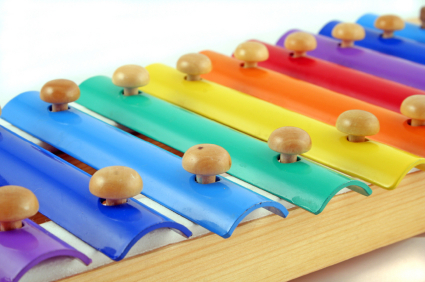
There is a developmental sequence to music and movement and how it links to a child’s development.
Every element of development and learning is crucial to the overall holistic development for a child and this too includes music and movement.
A age related break it down whereby we have a closer look on the development and impact of music.
Stage related development of music
Infants:
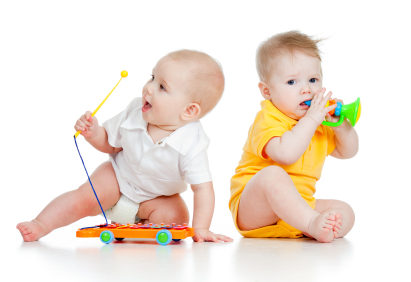
Will respond to music through movement usually with their entire body, by doing actions such as bouncing if they are on a knee, swaying side to side or bending up and down at the knees or moving their whole body to ‘dance’ to the music. They will respond livelier to action songs and more subdued to the softer songs. They will be comforted by soft rhythmic sounds and respond well to human voices, particularly their primary caregivers.
Toddlers:
Will primarily use their arms and legs and can move more in time to the tempo. They will often dance upon request and show more control over their physical responses. They will ‘wiggle their hips’ on command at times! They enjoy and respond well to repetition and rhyme so will enjoy simple action songs and finger plays. They will explore sound making by using anything they can find to make sounds- toys, household utensils, musical instruments, their own voices, etc. They will experiment with songs and singing and will demonstrate knowledge of sounds and music by identifying familiar songs and sounds.
3 year old:
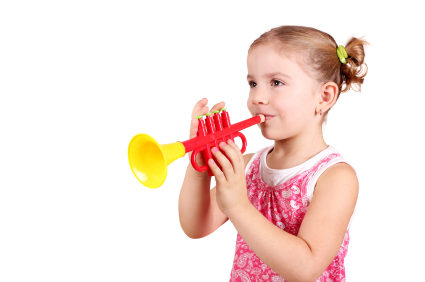
They have better voice control and can master songs and will have their own favourite songs. Most are becoming aware of the simple concepts of music such as beat, tempo, and pitch. They will move much more coordinately to music and will experiment with other types of body movements and their movements tend to be more graceful and precise.
4 year old:
They are learning the musical concepts such as pitch, duration, tempo and loudness. They will sing songs from memory with greater pitch control and volume control and will sing more songs as their vocab is expanding to facilitate this. They usually enjoy listening and joining in to group singing games and more complex songs. Their movements are becoming more rhythmic and are likely to be accompanied by actions or a spontaneous song.
5 year old:
Their senses of musical concepts such as pitch, melody and rhythm have emerged and they are understanding and developing the ability to conquer melodic contours and intervals (such as skip and steps in melody) and concepts (such as fast/slow, etc). Their vocal range is developing to now be a range of 5 or 6 notes. Their movement is much more rhythmic and interpretive in quality then before. They can follow simple multi tasked directions such as marching in a circle along with simple dance movements.
6, 7 & 8 year old:
They can sing in tune to the songs and have a vocal range of around 8-10 notes and singing in harmony is emerging. They will develop the ability to sing in a round and master a 2 part harmony with adult direction. They enjoy silliness and word play within the music and lyrics. Sequencing skills and memory for music and movement has developed and their musical preferences are generally developed. They may express an interest to actually play an instrument and they have the awareness of printed music. They are able to improvise with movements and match those of others or those that are in the song/music and can follow more complex instruction in relation to movement within the music.